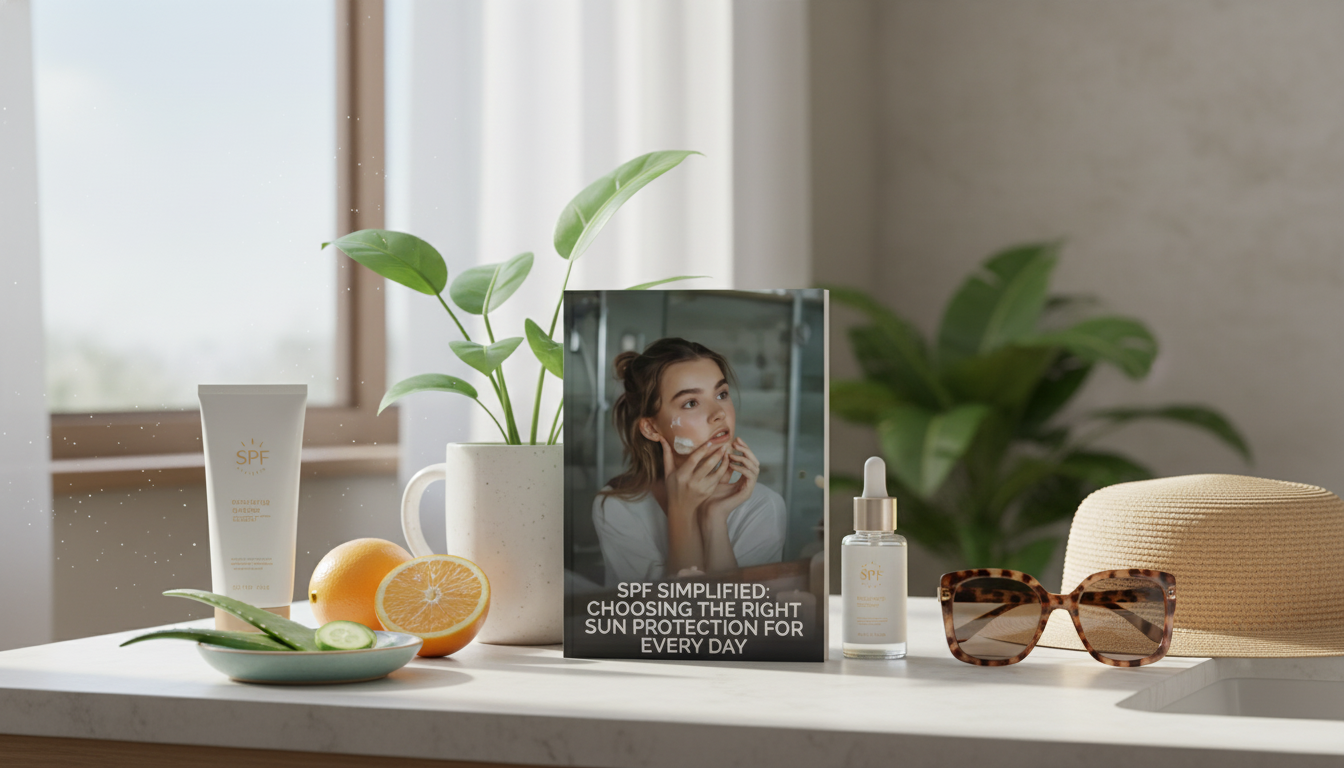
SPF Simplified: Choosing the Right Sun Protection for Every Day
Daily sun protection works best when it matches real life: time outdoors, window light, climate, skin tone, sensitivity, and how often reapplication is realistic. The goal isn’t chasing a “perfect” number—it’s choosing a broad-spectrum sunscreen you’ll actually wear, applying enough, and covering the areas that get the most exposure.
What SPF really measures (and what it doesn’t)
SPF (Sun Protection Factor) mainly tells you how well a sunscreen helps protect against UVB rays—the type most associated with visible sunburn. That’s useful, but it’s not the whole story for daily skin goals like preventing uneven tone or supporting long-term skin health.
- SPF is mostly UVB-focused. UVA rays penetrate deeper and are strongly linked to photoaging and cumulative damage.
- “Broad-spectrum” matters. Broad-spectrum labeling indicates protection against both UVA and UVB, making it a better everyday baseline than an SPF number alone.
- Higher numbers help, but not in a straight line. The jump from SPF 30 to SPF 50 can be meaningful for high-exposure days, but under-applying or skipping reapplication usually has a bigger impact than choosing a very high SPF.
- No sunscreen blocks 100%. Sunglasses, hats, UPF clothing, and shade are still part of a complete routine—especially during peak sun hours.
A simple way to choose an SPF number for daily use
If picking sunscreen feels complicated, use a two-tier approach: choose a “default” you can stick with, then a higher-protection option for days with more exposure.
- Daily baseline: Broad-spectrum SPF 30, applied generously in the morning.
- Move up to SPF 50 when the UV index is high, you’ll be outside longer, there’s strong reflection (water, snow, sand), or your skin is very fair, prone to hyperpigmentation, or using sensitizing actives.
- SPF 15 can be reasonable only for truly low-exposure days (mostly indoors, minimal window time), but it’s easier to under-apply—many routines stay more consistent with SPF 30+.
- Choose water-resistant formulas for sweat, sports, humidity, beach, or pool days; otherwise protection can drop quickly.
Quick pick: SPF number by everyday scenario
| Scenario |
Good everyday SPF choice |
Notes to make it work |
| Mostly indoors, short errands |
SPF 30 (broad-spectrum) |
Apply once in the morning; consider reapplying if near windows for hours |
| Desk near windows / commuting |
SPF 30–50 (broad-spectrum) |
Prioritize UVA protection and even coverage on cheeks, nose, and hands |
| Outdoor lunch or long walk |
SPF 50 (broad-spectrum) |
Reapply after ~2 hours outdoors; use hat/shade when possible |
| Beach, hiking, sports, sweating |
SPF 50 (water-resistant) |
Reapply every ~2 hours and after sweating/swimming; cover ears/scalp line |
UVA, UVB, and visible light: what matters for daily skin goals
Daily sun protection isn’t only about beach days. UVA rays can be a steady background exposure—especially during commutes or when sitting near windows.
- UVA can penetrate window glass. Broad-spectrum sunscreen helps when driving or working near a bright window. The American Academy of Dermatology also emphasizes broad-spectrum coverage as a daily standard.
- Visible light can matter for uneven tone. For melasma-prone skin or post-acne marks, tinted mineral sunscreen with iron oxides can provide extra help against visible light triggers.
- Blue light from screens is weaker than sunlight. For most routines, overall light exposure (windows + outdoors) is the bigger factor than device screens.
- Stack barriers when possible. Hats, sunglasses, and seeking shade add protection without needing a perfect reapplication schedule.
For more detailed sunscreen guidance, see the American Academy of Dermatology Association: Sunscreen FAQs and the U.S. Food & Drug Administration: Sunscreen—How to Help Protect Your Skin from the Sun.
Choosing a formula that matches skin type and routine
The “best” sunscreen is the one you’ll use consistently. Comfort, finish, and layering matter as much as the SPF label.
- Oily or acne-prone: Lightweight fluids, gels, or non-comedogenic options can feel less greasy and reduce the temptation to skip.
- Dry or sensitive: Creamier sunscreens or moisturizer-SPF hybrids can improve comfort; fragrance-free formulas often feel gentler.
- Deep skin tones: Look for formulas designed to minimize white cast—many chemical sunscreens or tinted mineral options blend more seamlessly.
- Makeup wearers: Choose a sunscreen that plays well under makeup, then plan a realistic reapplication method (patting a fluid, a cushion format, or a sunscreen stick that doesn’t disturb base makeup too much).
If a sunscreen pills, stings, or leaves a cast, it’s not a “you” problem—it’s a mismatch. Switching textures or filter types often fixes the consistency issue without lowering protection goals.
How much to apply and where people miss
A practical daily sun care routine (morning to reapplication)
Morning
If you use actives
Midday
Evening
Using digital guidance and AI-style tracking to stay consistent
Helpful digital guides for building a repeatable routine
FAQ
Is SPF 30 enough for daily use?
Broad-spectrum SPF 30 is a solid daily baseline for many routines, as long as it’s applied generously. Move up to SPF 50 when you’ll be outdoors longer, the UV index is high, there’s strong reflection, or you’re prone to hyperpigmentation or using sensitizing actives.
What’s the difference between SPF 50 and SPF 100?
SPF 100 offers a smaller incremental benefit than the jump from lower SPFs, and real-world protection often depends more on using enough and reapplying. Broad-spectrum UVA coverage, even application, and reapplication habits usually matter more than chasing the highest number.
Do you need sunscreen indoors?
It depends on your light exposure: UVA can come through window glass, so sunscreen makes sense if you drive often or sit near bright windows. In interior rooms with minimal daylight, many people take a more practical approach and prioritize sunscreen for outdoor time and window-heavy days.
Recommended for you










Leave a comment