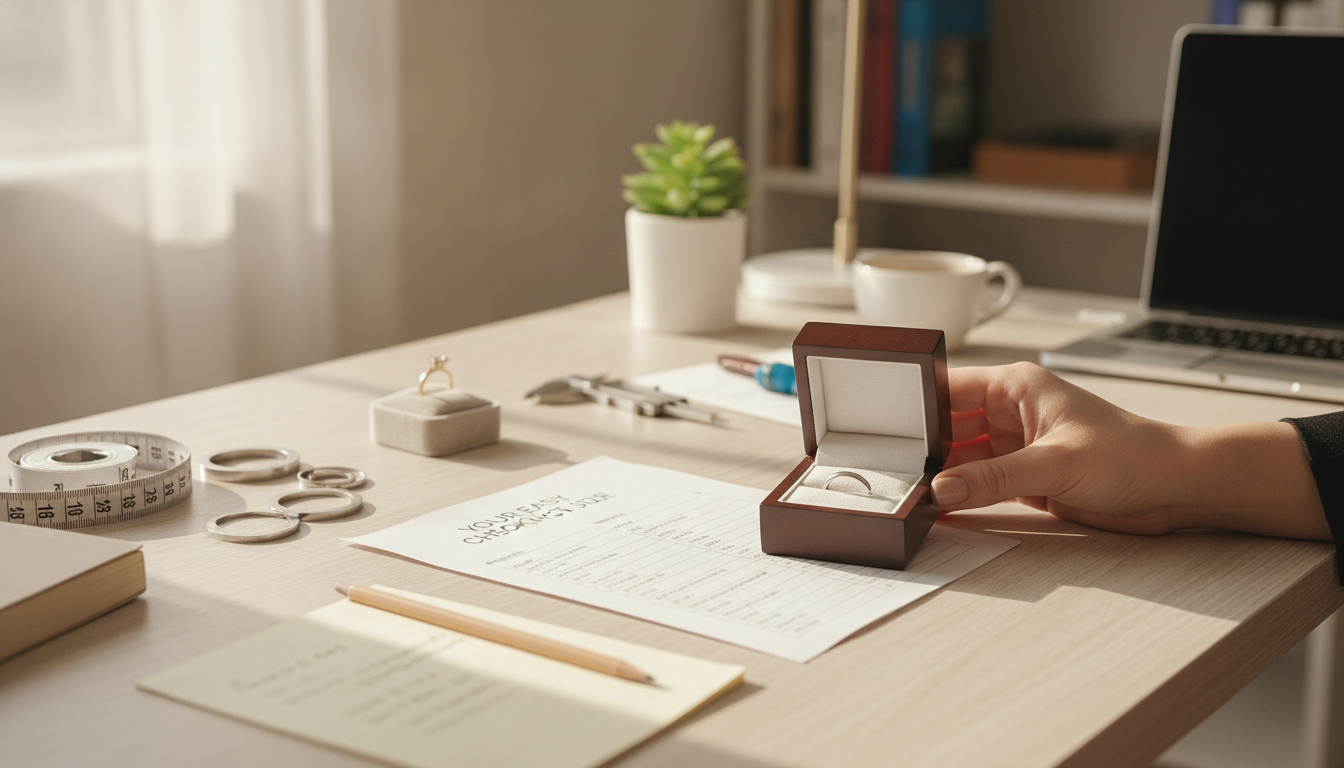
Getting a ring size right matters for comfort, surprise gifts, and big moments like engagements. A printable ring sizing checklist makes it easier to measure accurately at home, avoid common mistakes (like measuring at the wrong time of day), and choose a size confidently for yourself or someone else—then keep the guide handy for future purchases.
Ring sizing seems straightforward until real life gets involved. The good news: most sizing “mysteries” come from a few predictable variables you can plan around.
For a deeper reference on sizing systems and standards, see International Ring Size Standards (ISO 8653).
Three reliable at-home approaches can get you very close to a jeweler-grade result—especially when you use a light touch and double-check your work.
Cut a narrow strip of paper, wrap it around the base of your finger (where the ring will sit), mark where the paper overlaps, then measure that length with a ruler. Keep the strip flat and snug, not tight.
If paper isn’t available, use a non-stretchy string. Wrap gently, mark, and measure. The biggest risk here is pulling the string too tight or using a material that compresses.
For gifts (or if you already own a well-fitting ring), measure the inner diameter only. A printed circle guide can help match that diameter to a size chart. Make sure the ring you’re measuring is worn on the same finger—a “ring size” isn’t universal across every finger.
If two methods disagree, don’t average wildly different numbers. Re-measure with a lighter touch and try again at a different time of day. For general sizing guidance, GIA’s overview is a helpful reference: GIA: Ring Size Guide.
| Method | Best for | Watch out for |
|---|---|---|
| Paper strip | Most people; quick and consistent | Don’t wrap too tight; keep strip flat |
| Non-stretch string | When paper isn’t available | String can stretch or compress and skew results |
| Existing ring measurement | Surprise gifts; using a ring they already wear | Must be worn on the same finger; measure inner diameter only |
| Multiple checks | Anyone between sizes or buying online | Don’t average wildly different numbers—re-measure instead |
For a ready-to-print option, see our Printable Ring Sizing Guide (Digital Download).
Common signs include a ring that fits in the morning but feels tight later, or a ring that goes over the knuckle with effort but spins once it’s on. Re-measure at different times, factor in band width, and choose the size that stays comfortable for several hours.
Evening measurements are usually closer to an everyday average because fingers tend to swell slightly during the day. Avoid measuring right after exercise, heat exposure, or time spent in the cold.
Yes—when it’s printed at 100% and you confirm the scale using the guide’s reference measurement or a ruler. Most inaccuracies come from printer scaling settings or skipping the scale check.









Leave a comment